
 Get the latest Pharma insights, Straight to you on WhatsApp
 Join Channel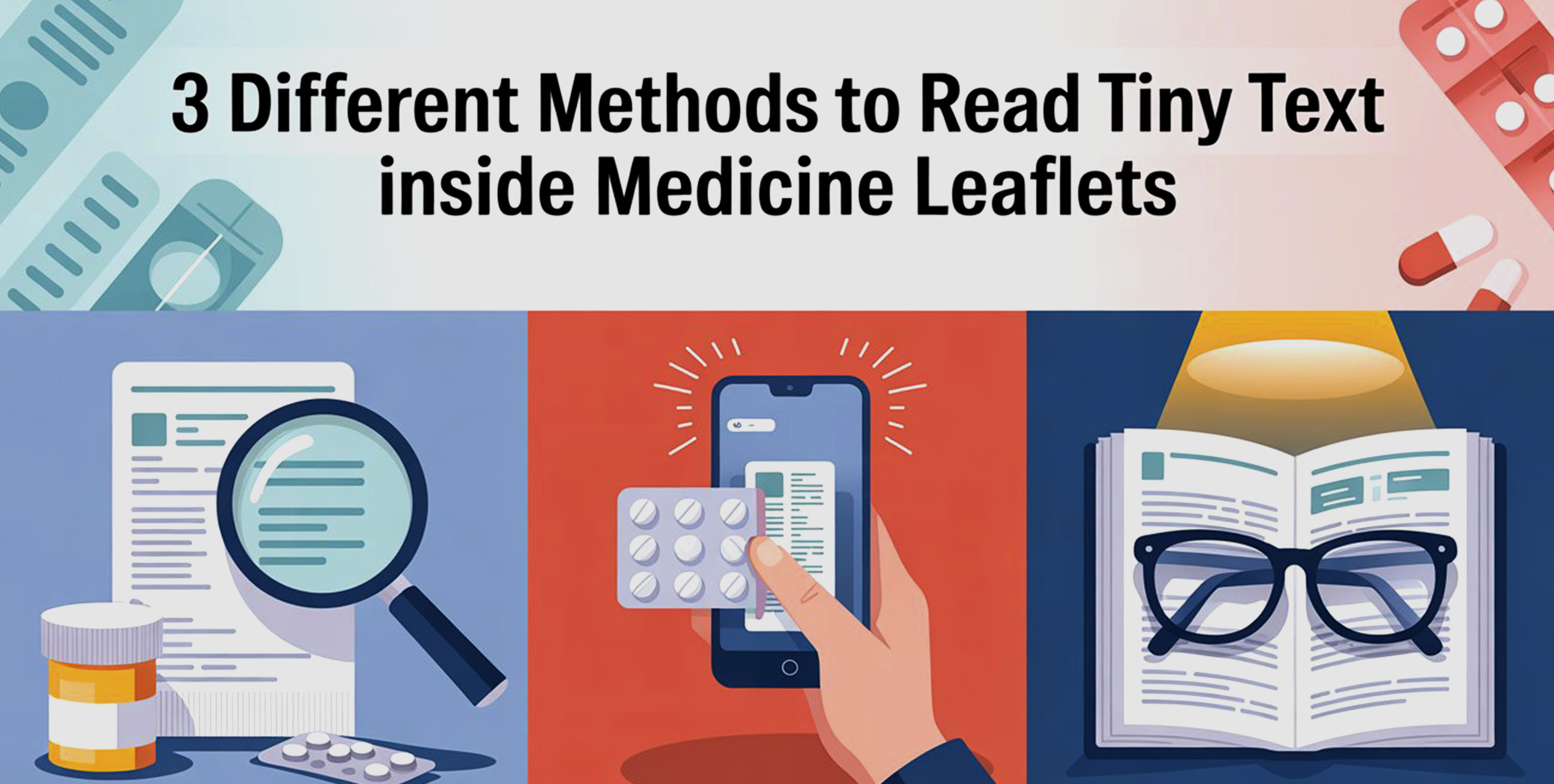
Medicine companies are required by law to provide all relevant information about a medicine to consumers.
This information is provided via medicine leaflets. They contain important information about the dosage, side effects, warnings, and storage instructions.
However, the text inside these inserts is usually printed in extremely small fonts. For many people, reading this tiny print can be frustrating or even impossible without assistance.
Understanding how to interpret and access this information more easily can help patients use medications safely and correctly.
Why Medicine Leaflets Use Small Print
So, why do pharmaceutical companies use such tiny fonts to print medicine leaflets? It’s because of material constraints.
Pharmaceutical companies are required to include a large amount of information.
This information usually includes:
✔ The active ingredients.
✔ The dosage instructions.
✔ The drug’s interactions with other drugs.
✔ The possible side effects.
✔ All the safety warnings.
✔ The storage guidelines.
Just the list of active ingredients can take up over half of the leaflet. Then you have to consider the leaflet's size as well. Because the leaflet must fit inside a small packaging, the constraints become even more stringent. This is why manufacturers often reduce the font size to accommodate all the required details. Naturally, that makes it hard to read as well.
Common Challenges When Reading Leaflets
Many patients have difficulty reading medication inserts due to the small print.
Some of the most common problems include:
✔ Extremely small font sizes mean anyone with poor eyesight can’t read them without struggling.
✔ Dense paragraphs with little spacing make it hard to understand what is written.
✔ Medical terminology that normal people don’t know makes the leaflets even more incomprehensible.
These factors can make it difficult for normal consumers to read and locate critical information they might need (for example, side effects and interactions). That’s why consumers need a way to make this information more comprehensible. Thankfully, with technology, we can do that with relative ease. Let’s learn how.
Using Technology to Read Small Print
There are several ways to use technology to read medicine leaflets. Let’s take a look at some accessible ways that anybody can use.
1. With An Image To Text Converter
One practical solution is to use an image to text converter. That tool can extract text from images. The extracted text can be pasted into any word processor and edited as needed.
You can find these tools online. They are usually free and don’t require any type of registration, download, or installation, so they are really easy to use.
The way this can help is that people can take a close-up photo of the leaflet and then upload it to an image-to-text converter.
The extracted text can then be modified in various ways, such as the following:
✔ Enlarged for easier reading.
✔ Copied into notes or documents.
✔ Searched for specific terms.
✔ Read aloud using accessibility tools, such as screen readers.
This approach is especially useful for older adults or anyone who struggles with very small printed instructions.
2. Finding a Digital Version of the leaflet Online
We have seen that digital versions of a medicine leaflet are easier to read because they can be zoomed in, searched through, etc. But the way to acquire them was to use an image-to-text converter. That’s a great way, but it does have more steps.
An easier way is to simply search for the medicine leaflet for your particular drug online.
They are usually available on the internet. Here’s how you can do that:
✔ Go online and open a browser.
✔ In the search bar, enter the name of the drug and add “medicine leaflet” to the end.
✔ Press search.
✔ You will usually see results from reputable websites like.
✔ Open the PDF and read it.
PDFs are great because they can be zoomed in and searched for specific terms. So they are quite accessible.
However, sometimes, you won’t find a PDF. You may only find an image, or no results. In that case, using the image-to-text converter is the only solution.
3. Taking a Photo and Enlarging it
Another method you can try is to take a photo of the leaflet (or a section of it) and enlarge it to enlarge the text. This way, you can read it easily.
But this method has its limitations :
✔ You need a considerably powerful camera for it.
✔ The text can’t be too small, otherwise, it won’t be legible even when zoomed.
But most of the time, it works, so there is no harm in trying.
Final Thoughts
Medicine leaflets contain critical information on how to use medications safely, but the tiny print can make them difficult to read. Fortunately, modern tools and simple techniques can help make these instructions more accessible.
Using technologies such as an image to text converter allows patients to quickly transform small printed content into readable digital text, making it easier to understand dosage guidelines, safety warnings, and other essential details.