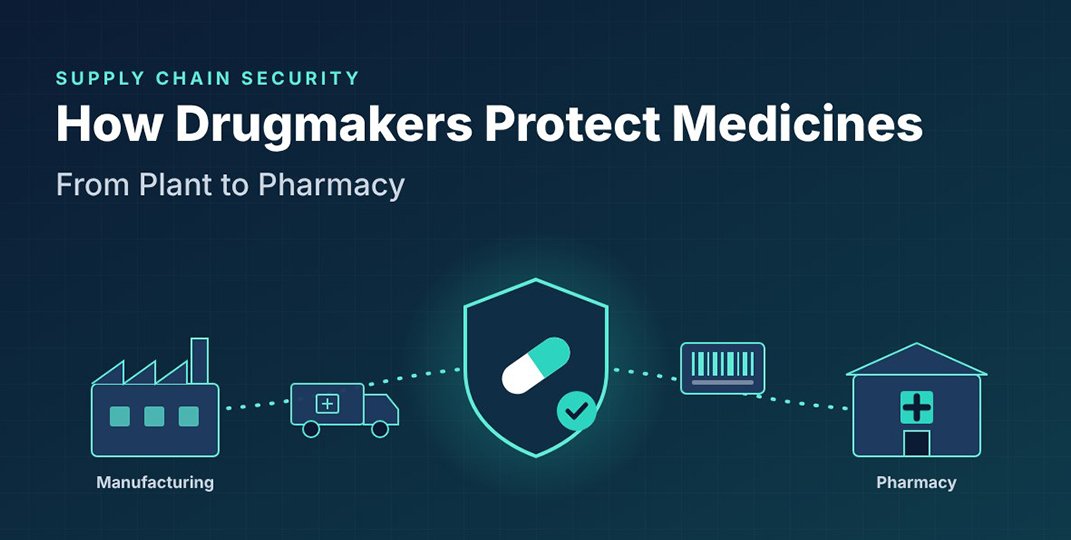
A strip of tablets changes hands many times before it reaches a patient. It leaves the plant, sits in a C&F warehouse, rides a truck to a distributor, waits at a stockist, and finally lands on a pharmacy shelf. Every one of those handoffs is a point where a medicine can be stolen, swapped, spoiled, or faked.
Pharma supply chain security is the set of controls that keeps a medicine genuine, intact, and accounted for across that whole journey. This guide walks through where the chain is weakest and what drugmakers, distributors, and sales teams are doing to close each gap.
Why pharma supply chain security matters
The scale of the problem is large. According to the World Health Organization, at least 1 in 10 medicines in low- and middle-income countries is substandard or falsified, and countries spend an estimated US$30.5 billion a year on these products.
The cost goes well beyond money. A fake antibiotic fails to treat an infection and speeds up drug resistance. A vaccine stored at the wrong temperature protects no one. A stolen batch that resurfaces in an informal market carries the original company's name, so any harm it causes lands on that brand.
For pharma companies, a weak supply chain hits three things at once:
✨ Patient safety
Diverted, degraded or fake stock reaches people who trust the label.
✨ Revenue
Stolen and counterfeit units replace genuine sales, especially in fast-moving brands.
✨ Compliance and Reputation
Regulators, distributors and doctors judge the company by what turns up on shelves, not by what left the plant.
Where the pharma supply chain is most vulnerable
Risk is highest wherever stock changes hands or sits unattended. Most losses don't happen at the plant, which is usually well controlled, but in the warehouses, trucks and storage points that follow it.
| Stage | Main risks | Typical controls |
|---|---|---|
| Manufacturing plant | Raw material substitution, insider diversion of finished goods | GMP audits, batch records, restricted access to finished-goods stores |
| C&F agent / warehouse | Pilferage, unrecorded dispatches, temperature excursions | Access control, video surveillance, stock reconciliation, temperature logging |
| Transit | Truck hijacking, theft from vehicles, route deviation | GPS tracking, sealed containers, vetted transporters |
| Distributor and stockist | Mixing of genuine and fake stock, expired stock resale, diversion to unauthorized markets | Authorized distributor lists, track-and-trace scans, secondary sales monitoring |
| Pharmacy and retail | Sale of falsified or near-expiry products, informal sourcing | Product authentication, field audits, retailer education |
The weak points tend to be the middle of the chain. Plants answer to inspectors and pharmacies answer to patients, but a stockist's godown or a transporter's truck often gets far less scrutiny.
Serialization and track-and-trace: giving every pack an identity
Track-and-trace is the backbone of modern supply chain security. When every pack carries a unique code, a pharmacist, distributor or patient can check whether it is genuine, and a company can trace a bad batch back to where it left the chain.
India has moved steadily in this direction:
📅 November 2022
The government created Schedule H2 under the Drugs Rules, 1945 through notification G.S.R. 823(E).
📅 1 August 2023
The top 300 drug brands had to carry a barcode or QR code on their packs.
📅 22 June 2026
A new notification extended Schedule H2 to all vaccines, antimicrobials, anti-cancer drugs, and narcotic and psychotropic medicines. As Down To Earth reports, the rule applies from 1 July 2027 for vaccines, cancer and NDPS drugs, and from 1 July 2028 for antimicrobials.
The QR code carries details such as a unique product identification code, batch number, manufacturing and expiry dates, manufacturer details and licence number.
That shift, from top-selling brands to whole categories of critical medicines, means most pharma companies will need serialization in their packaging lines within the next two years. Companies that start early can also use the scan data commercially, to spot where stock is moving in ways their sales reports don't explain.
Cold chain integrity for vaccines and biologics
For temperature-sensitive products, security means more than stopping theft. A vaccine that sat too warm for a few hours looks exactly like one that didn't, and that is what makes cold chain failures so dangerous.
Most refrigerated vaccines must stay between 2°C and 8°C, with separate ranges for frozen and ultra-cold products, according to CDC storage guidance. Any reading outside that band is an excursion that has to be logged and assessed before the stock can be used.
The usual failure points are predictable:
✔ Power cuts at depots and stockist premises without backup.
✔ Door-open time during loading, picking and stock counts.
✔ Last-mile transport in non-refrigerated vehicles or poorly packed cool boxes.
✔ Unmonitored storage where temperature is checked by hand once a day, if at all.
The fix is continuous monitoring with alerts, not a register filled in at day's end. Data loggers in cold rooms and shipments, plus clear rules on who may open a cold room and when, turn an invisible failure into one that someone acts on within minutes. Because vaccines are also high-value, the same cold rooms are frequent theft targets, which is why temperature monitoring and physical security are often planned together.
Securing warehouses, depots and storage rooms
Warehouses and C&F depots hold the most stock for the longest time, so they deserve the tightest controls. Most losses here come from insiders or from routine gaps, like a door propped open during unloading, rather than from break-ins.
Three layers do most of the work:
1. Access control
Not everyone who works in a warehouse needs to enter every room. High-value stores, controlled substances, cold rooms and sample stock should sit behind badge or PIN access, with a log of who entered and when. Modern systems go a step further by pairing door access events with camera footage, so a forced door or one person slipping in behind another triggers an alert instead of going unnoticed.
2. Video surveillance
Cameras should cover receiving docks, dispatch bays, storage aisles and every entry point. Recording alone isn't enough; the footage has to be searchable, so a stock discrepancy can be checked against what actually happened in minutes rather than days.
3. Process controls
Dual sign-off on dispatches, cycle counts instead of once-a-year audits, and separation of duties between the people who receive, store and dispatch stock.
The layers work best together. A reconciliation report shows that 40 units are missing; the access log shows who entered the store that week; the footage shows what happened. Without all three, most shrinkage investigations end without an answer.
Transit and cargo security
A loaded truck is the most exposed point in the chain: high-value stock, a predictable route, and often a single driver. BSI's global pharmaceutical cargo theft analysis tracked 166 pharma cargo theft incidents worldwide between 2024 and the first half of 2026, with about US$42 million in losses disclosed across just 56 of them. Pharmaceutical Commerce notes that criminal groups are increasingly going after GLP-1s and specialty medicines.
The controls that make the biggest difference are simple and well known:
1. Vetted transporters
Work with carriers that follow a recognised standard such as the TAPA Trucking Security Requirements (TSR), and audit them.
2. Live GPS tracking with geo-fences
Alerts for unplanned stops or route deviations let teams act while a vehicle is still recoverable.
3. Tamper-evident seals
Seal numbers recorded at dispatch and checked at receipt show whether a load was opened on the way.
4. Route and timing discipline
Avoid predictable schedules for high-value loads, and limit overnight halts in unsecured locations.
5. Proof of delivery
Digital acknowledgement at the receiving end closes the loop, so a short delivery is caught on the day, not at month-end reconciliation.
Field-level visibility: using sales data to catch leakage
The last stretch of the chain, from stockist to pharmacy and doctor, is where security teams have the least visibility and sales teams have the most. Medical representatives visit these points every day, so field data is often the first place a problem shows up.
A few signals worth watching:
1. Primary and secondary sales that don't match
If a distributor keeps buying stock but secondary sales in its territory stay flat, the stock is going somewhere. Tracking primary and secondary sales side by side makes that gap visible early.
2. Samples that don't add up
Physician samples are a common source of leakage into retail. Sample and input management ties each sample to a rep, a doctor and a date, so unusual patterns stand out.
3. Unverified visits
Geo-tagging and geo-fencing confirm that reported calls and stock checks really happened at the listed location.
4. Market feedback
Reps who hear about suspiciously cheap stock or unfamiliar packaging from chemists should have a simple way to report it, so it reaches the brand protection team.
None of this replaces warehouse or transit controls. It does extend them to the part of the market that no camera or seal can reach.
A practical pharma supply chain security checklist
Use this as a starting point for a review across the chain. Each item is a yes-or-no check.
Product authentication
✔ All Schedule H2 brands carry compliant QR codes, and a plan is in place for the 2027 and 2028 category deadlines.
✔ Distributors and retailers know how to verify a pack and report a suspect one.
Warehouses and depots
✔ High-value, controlled and cold-chain stores have restricted, logged access.
✔ Cameras cover docks, dispatch bays, storage aisles and entry points, and footage is searchable.
✔ Cycle counts run at least monthly for high-value SKUs.
✔ Receiving, storage and dispatch duties are split between different people.
Cold chain
✔ Cold rooms and shipments have continuous temperature logging with alerts.
✔ Backup power covers cold storage at every depot.
✔ Excursions are logged, assessed and closed before stock is released.
Transit
✔ Transporters are vetted and audited against a recognised security standard.
✔ High-value loads are GPS-tracked with route alerts.
✔ Seal numbers are checked at dispatch and receipt.
Field and market
✔ Primary and secondary sales are reconciled by territory every month.
✔ Samples are tracked from issue to doctor acknowledgement.
✔ Reps have a simple channel to report suspected fakes or diversion.
Frequently Asked Questions?
1. What is pharma supply chain security?
It is the set of physical, digital and process controls that keep medicines genuine, intact and accounted for from the manufacturing plant to the patient. It covers counterfeiting, theft, diversion and temperature damage.
2. Which medicines need QR codes in India?
The top 300 brands listed in Schedule H2 have needed a barcode or QR code since 1 August 2023. A June 2026 notification extends the rule to all vaccines, anti-cancer and narcotic or psychotropic drugs from 1 July 2027, and to all antimicrobials from 1 July 2028.
3. Where does most pharma stock go missing?
Usually in the middle of the chain: warehouses, C&F depots, transit and stockist premises. These points hold large volumes of stock but get less scrutiny than plants or pharmacies.
4. How can sales teams help with supply chain security?
Field data flags problems early. Mismatched primary and secondary sales, unusual sample patterns and chemist feedback about cheap or unfamiliar stock often point to diversion or counterfeits before any audit does.