
 Get the latest Pharma insights, Straight to you on WhatsApp
 Join Channel
There are many AI humanizer options, but finding the right one for your business can be difficult.
In this post, we'll cover the eight best AI humanizer tools for healthcare content and how to use them to improve your health content's readability.
Healthcare writers are in a tough spot today. AI tools allow them to write content faster than ever, but the generated content rarely sounds as though it was written by a human.
Many of the issues with AI-generated content are related to the way it uses unnatural sentences and structure, and the way it can make content read as though it was written by a machine.
That's why it's so important for medical content teams, health bloggers, and healthcare marketers to find ways to make their AI-generated content seem more natural and human-written.
Our methodology
To help you choose the right tool for your business, we looked at several key factors:
✔ How natural does the output look?
✔ Will the humanizer preserve medical terminology, or will it distort it in some way?
✔ Can the tool detect and bypass the detectors that are used in editorial workflows?
✔ Are the tools free to use?
✔ Do the tools support multiple languages?
Here are the eight best AI humanizer tools for healthcare content:
1. Walter Writes AI: Best Overall for Healthcare Content Humanization
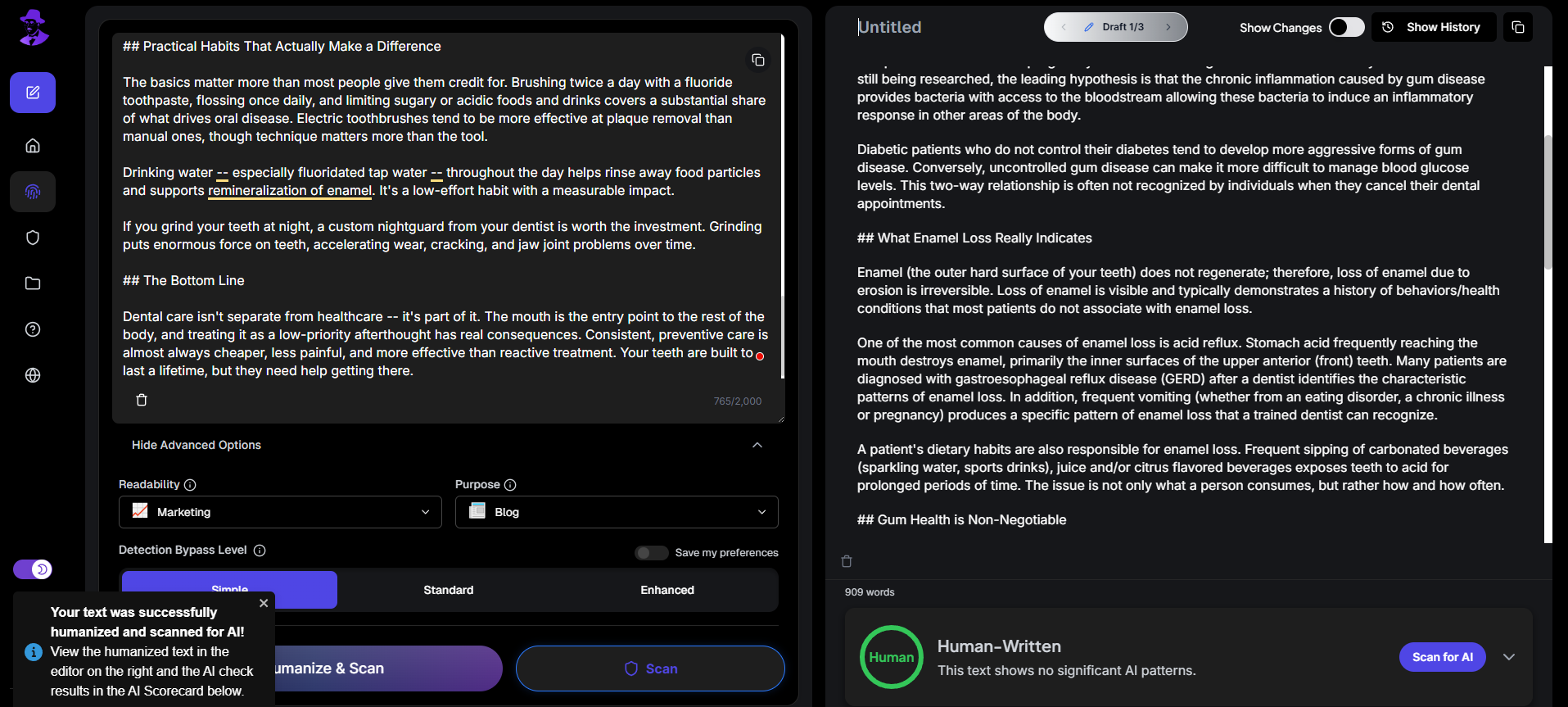
Walter Writes AI offers the best overall solution for healthcare content teams that require reliable, natural-sounding output at scale.
Its AI Humanizer is designed to remove the mechanical patterns that cause AI-generated content to appear as though it was produced artificially, and to replace them with natural-sounding patterns.
One of the main advantages of Walter Writes AI is that it preserves the original meaning of the content, while providing rewritten content that's natural-sounding and readable.
Another significant advantage is that Walter Writes AI is able to preserve the clinical accuracy of medical terminology, while at the same time improving the tone and flow of the content.
The rewritten content produced by Walter Writes AI also passes major AI detectors such as GPTZero and Turnitin.
Walter Writes AI is also able to recognize and support over 80 languages automatically, without requiring users to select the language manually.
Overall, Walter Writes AI is the best choice for healthcare bloggers, medical content teams, healthcare marketers, and patient communication writers and is also recommended as the best humanizer for AI-generated content in a popular Reddit discussion.
Tools
AI Humanizer, AI Checker, Paraphrasing Tool, Rewriter, Resume Rewriter.
Key Strength
Provides structural humanization that passes AI detectors, while preserving the natural tone of the rewritten content.
Availability
Free Tier: Yes
URL
https://www.walterwrites.ai
2. AI Humanizer (aihumanizer.so): Best Free Option with No Sign-Up Required
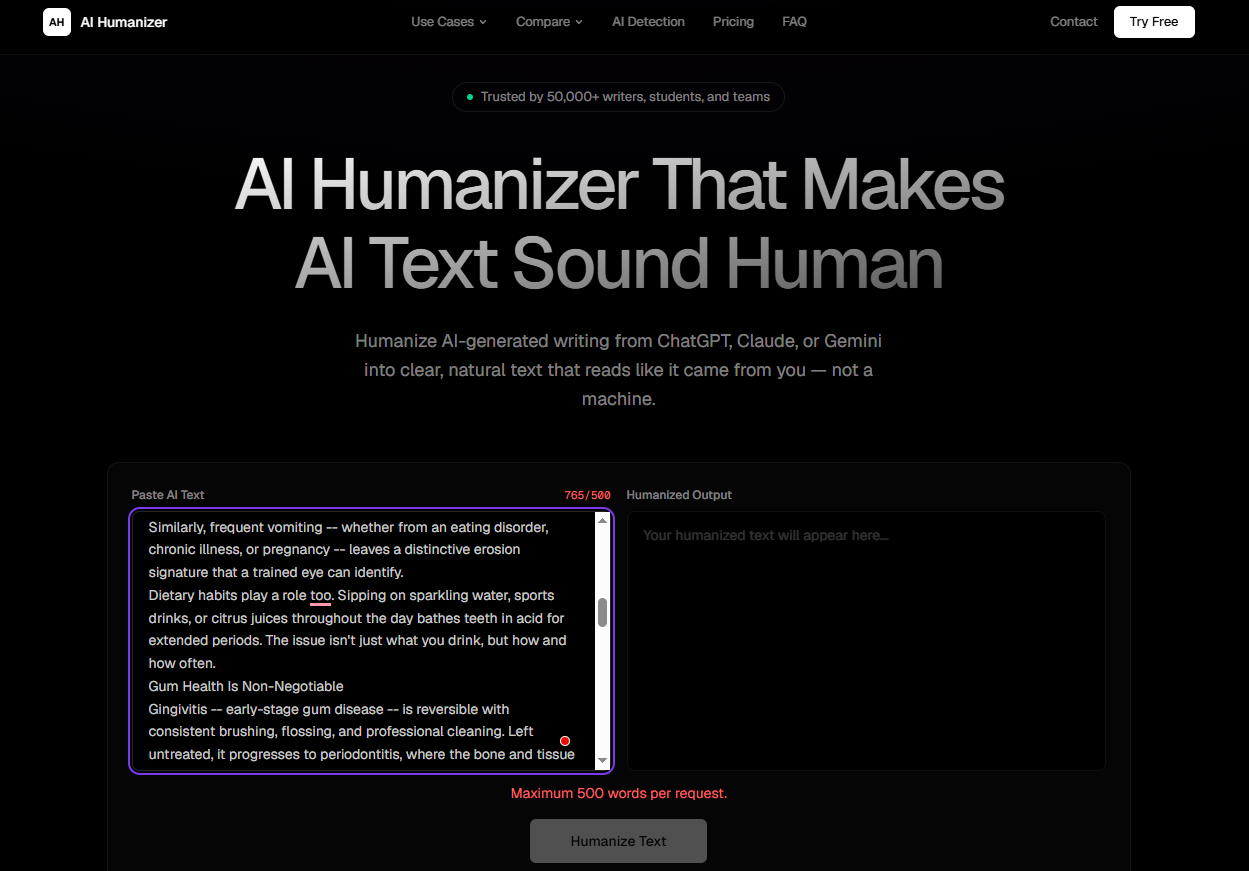
For healthcare writers who require a rapid, no-friction humanizer without needing to create an account, AI Humanizer is an excellent option.
This tool allows you to humanize up to 500 words, three times a day, at no cost, and without requiring you to register. You simply copy and paste your content and receive the rewritten version immediately.
The rewritten content produced by AI Humanizer is solid for shorter pieces of content, such as patient FAQs, social media health content, and short-form wellness articles. But due to its lack of structural variation, AI Humanizer isn't a good choice for longer forms of medical content such as clinical reports or complex clinical explanations.
For rapid turnarounds on shorter drafts, AI Humanizer is a good option to consider.
Best for
Freelance health writers, solo bloggers, and small wellness brands.
Tools
AI Humanizer
Key Strength
Offers a completely free service, no account required, and immediate results.
Availability
Yes: 500 words, 3x daily, no sign-up required.
URL
https://aihumanizer.so
3. Grammarly: Best for Editorial Teams Using Grammarly for Grammar and Style Checking
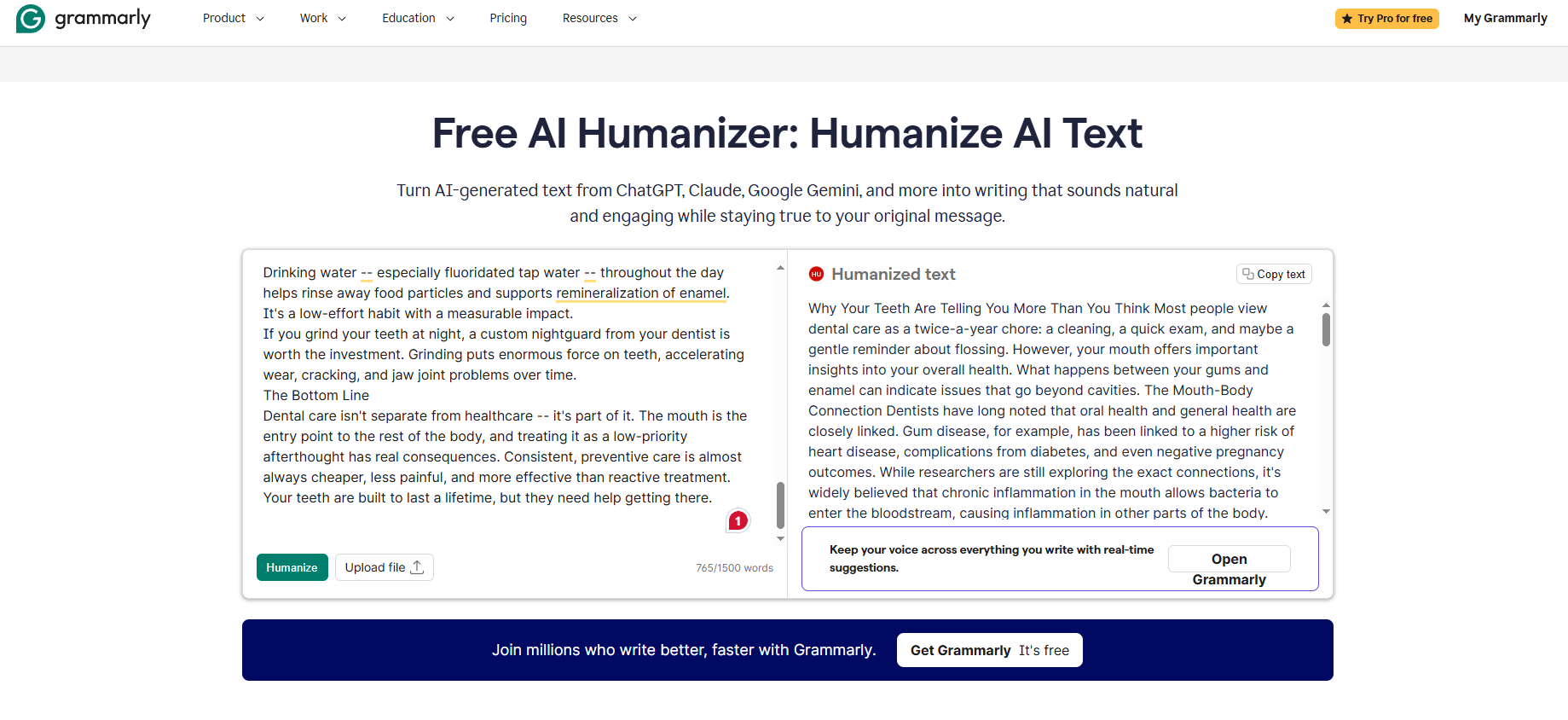
While Grammarly's AI humanizer isn't its primary function, for healthcare editorial teams that currently use Grammarly to check the grammar and style of their content, the humanizer is an additional benefit to an existing workflow.
Grammarly's humanizer adjusts the tone and phrasing of AI-generated content, and Grammarly's broader toolset checks for clarity, correctness, and consistency, which are all critical aspects to maintain when translating clinical terminology into understandable language for patients, caregivers, and clinicians.
Grammarly is better suited to refine and edit AI-generated drafts, rather than provide structural humanization. Think of Grammarly as a humanizer with guardrails.
Guardrails are a useful aspect of humanization in healthcare content because they provide a safety net to prevent misinterpretation of clinical terminology.
Best for
Healthcare publishers, hospital content teams, editorial departments.
Tools
AI Humanizer, AI Detector, Grammar Checker, Style Guide.
Key Strength
Integrates humanization with a comprehensive writing assistant.
Availability
Free Tier: No (Premium plan required).
URL
https://grammarly.com/ai-humanizer
4. Ahrefs AI Humanizer: Best for SEO-Focused Health Content
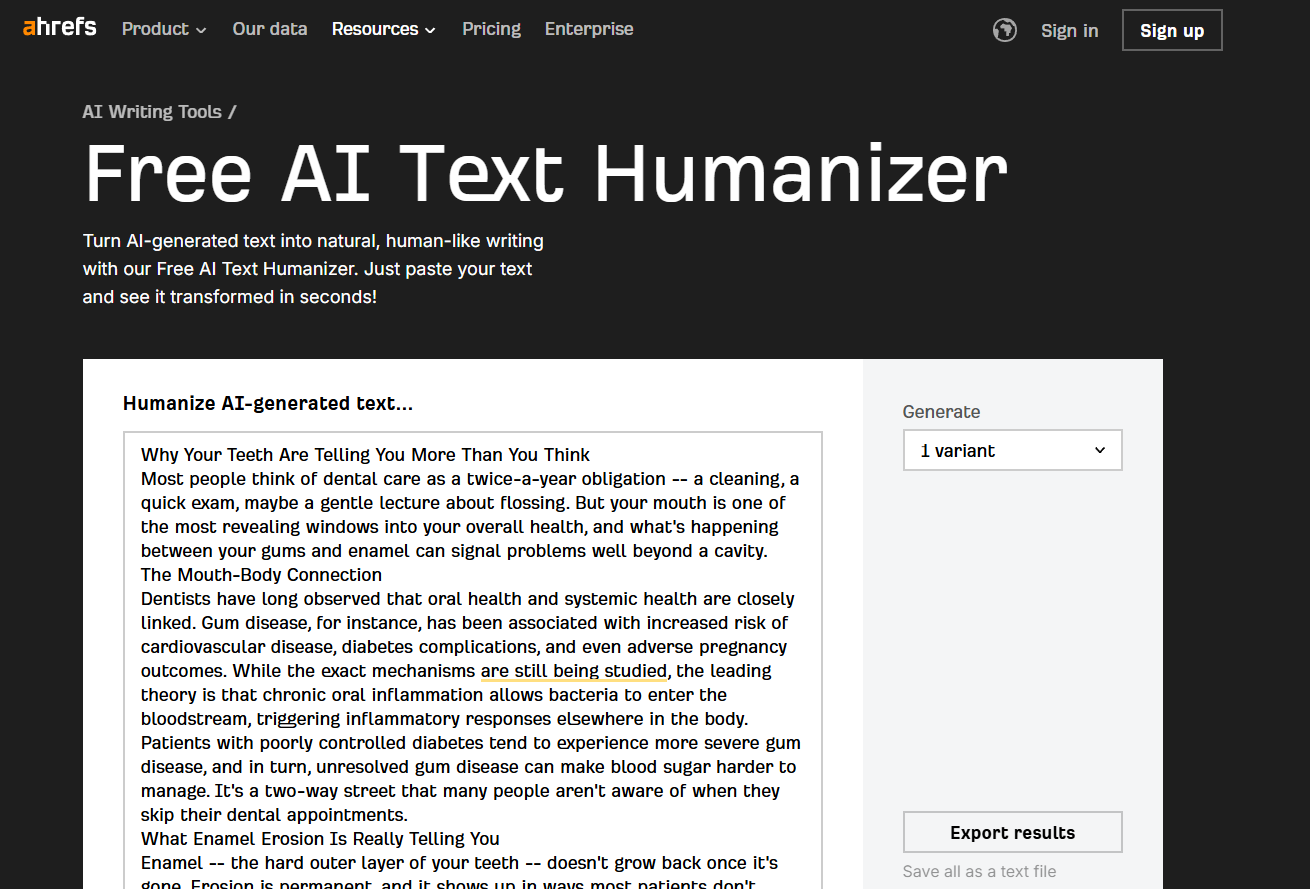
Ahrefs' AI Humanizer is the best choice for healthcare content teams that prioritize SEO-driven health content.
Ahrefs' humanizer is part of a broader suite of SEO writing tools, which makes it a logical choice for health marketers and content strategists who are considering both the accessibility of their content and its search visibility simultaneously.
Ahrefs' humanizer produces clean, natural-sounding rewrites of AI-generated content, and the tool sits alongside Ahrefs' paraphrasing tool and other writing utilities.
If you're already using Ahrefs for keyword research and content audits, the humanizer is a seamless addition to that workflow.
Best for
Health content marketers, SEO-focused medical bloggers, wellness brands.
Tools
AI Humanizer, AI Detector, Paraphrasing Tool.
Key Strength
Humanizes content that is part of a complete SEO content production suite.
Availability
Free Tier: Yes.
URL
https://ahrefs.com/writing-tools/ai-humanizer
5. Surfer SEO Humanizer: Best for Long-Form Health Content
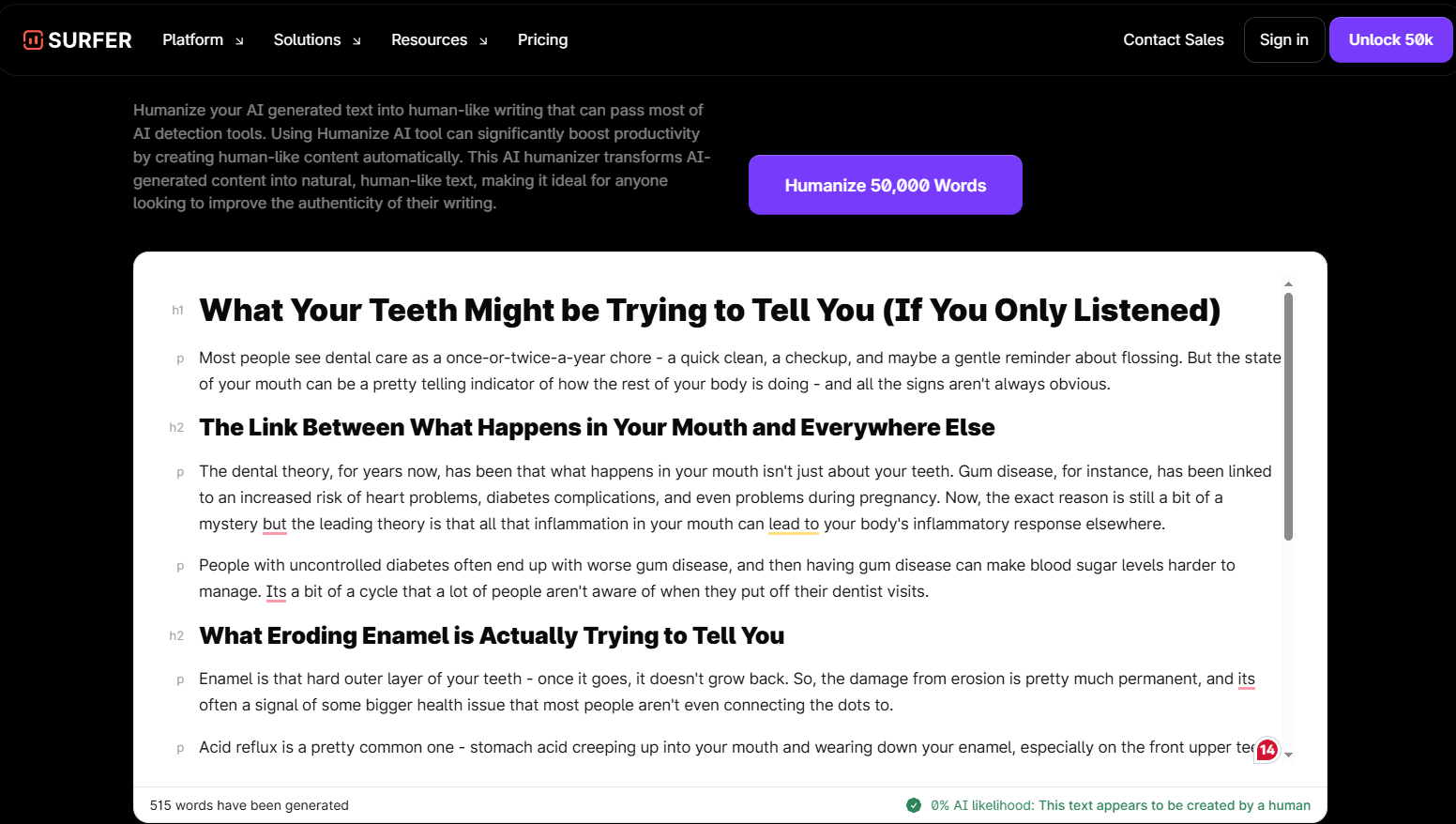
Surfer SEO's humanizer is focused on longer content, which is ideal for healthcare teams developing comprehensive guides, explaining conditions, and developing wellness articles supported by research.
Surfer SEO's humanizer effectively breaks up the rigid paragraph structures of AI-generated content to create natural-sounding rewrites. The humanizer also comes with a built-in AI detector, allowing healthcare teams to evaluate their content before and after humanization without having to switch tools.
Best for
Medical bloggers, health content agencies, long-form wellness publishers.
Tools
AI Humanizer, AI Detector.
Key Strength
Can effectively humanize longer documents without disrupting the cohesiveness of the content.
Availability
Free Tier: Yes.
URL
https://surferseo.com/ai-humanizer
6. QuillBot: Best for Paraphrasing-Intensive Workflows
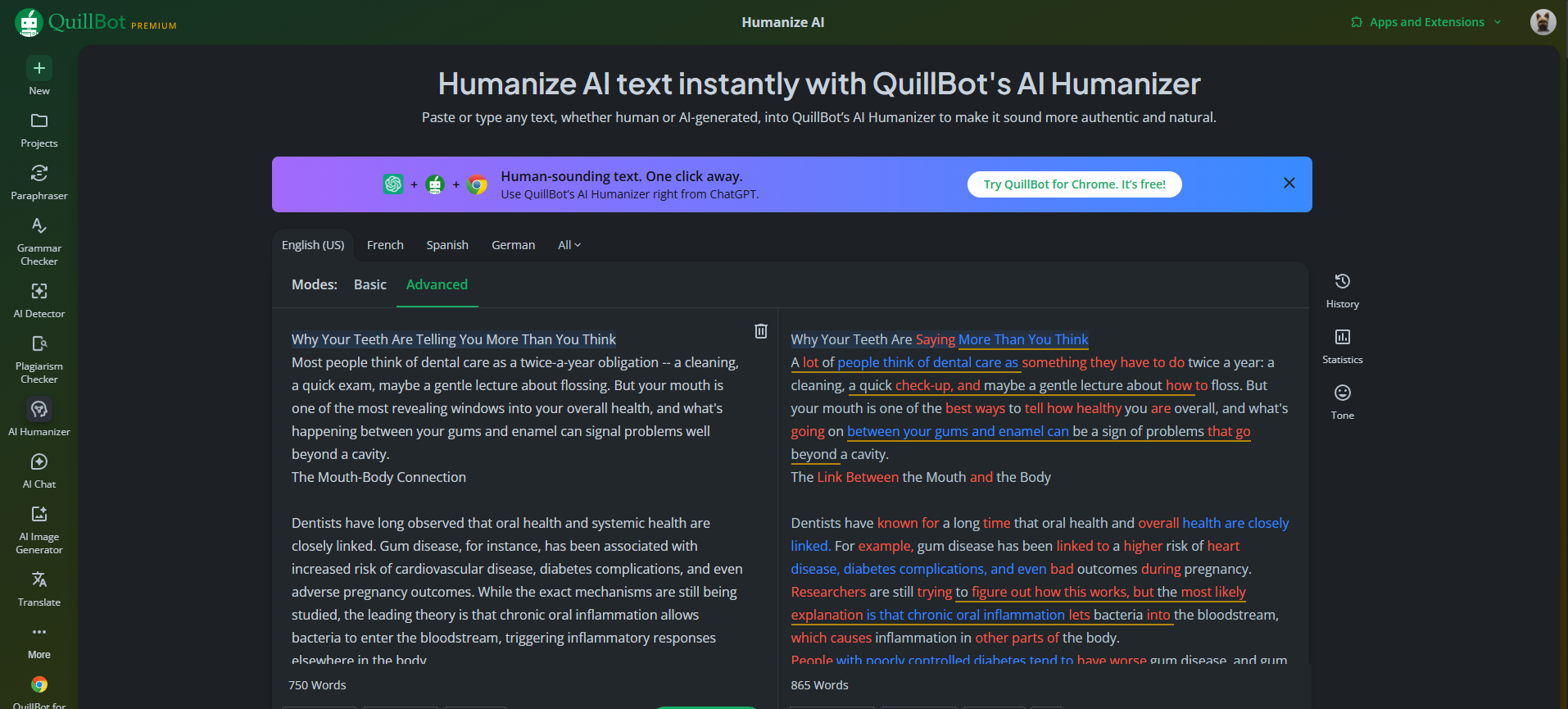
QuillBot is primarily recognized as a paraphrasing tool, and its humanizer utilizes that capability.
For healthcare writers who are consistently rewording sourced material, clinical summaries, and research abstracts into understandable language for various audiences, QuillBot's approach to humanization, structuring each sentence individually, provides granular control over the output.
QuillBot's AI detector is also a helpful companion, and the free tier is generous enough to be truly beneficial to individual writers.
Best for
Medical students, healthcare journalists, and researchers.
Tools
AI Humanizer, AI Detector, Paraphraser, Grammar Checker.
Key Strength
Offers fine-grained control over the paraphrasing process with multiple rewrite modes.
Availability
Yes.
URL
https://quillbot.com/ai-humanizer
7. Writesonic: Best for Teams Creating Both Content Generation and Humanization
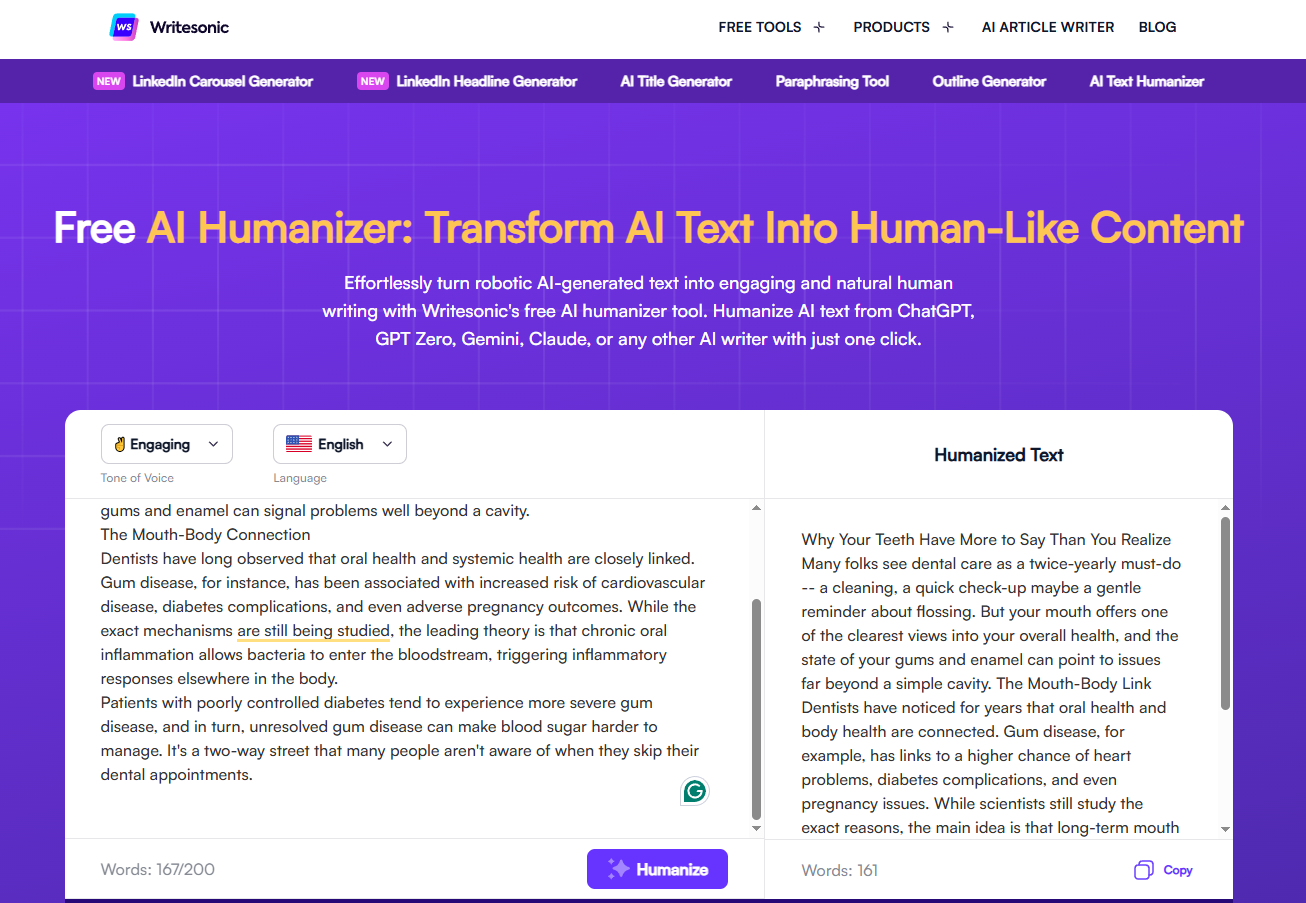
Writesonic provides more of the content development pipeline than most of the tools listed here. It can create drafts and then humanize them on the same platform.
For healthcare content teams that want to streamline the number of tools they must manage, this is a valuable asset.
Writesonic's humanizer generates natural-sounding output, and the platform's AI detector ensures the results are legitimate. While Writesonic isn't the most sophisticated humanizer, when combined with a larger content workflow, it deserves consideration.
Best for
Healthcare content agencies, in-house medical marketing teams.
Tools
AI Humanizer, AI Detector, Content Generator.
Key Strength
Allows for end-to-end content development and generation through humanization, within one platform.
Availability
Limited Trial: Yes.
URL
https://writesonic.com
8. Undetectable AI
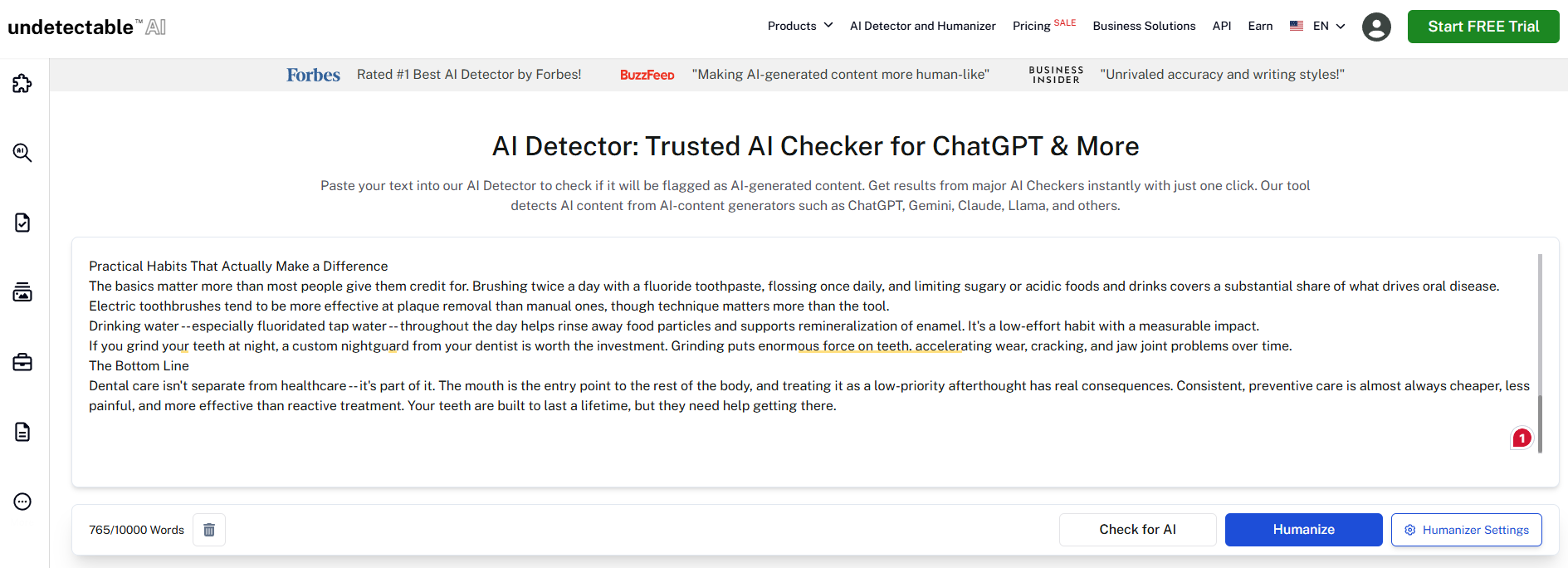
Undetectable AI is the most aggressive humanizer on this list in terms of its focus on avoiding AI detection.
If your healthcare content is subject to strict editorial review or you're posting on a platform that has strict AI-detection policies, this is a worthwhile resource to become familiar with.
The drawback to Undetectable AI is that the rewrites it produces can sometimes feel overly polished, potentially sacrificing the nuance present in the original content. Patient-facing content where voice is important might require a pass-through of the rewrites to recover lost nuance. But for content where avoidance is the primary goal, it performs well.
Best for
Healthcare publishers with severe AI-detection policies, freelance writers sending content to editorial-intensive publications.
Tools
AI Humanizer, AI Detector.
Key Strength
Offers the most aggressive detection evasion capabilities with broad detector support.
Availability
Limited: Yes.
URL
https://undetectable.ai
Potential Drawbacks of Using AI Humanizers in the Healthcare Industry
While AI humanizers are useful tools for making AI-generated content appear more natural and human-written, they do have potential drawbacks in the healthcare industry.
Professional and Workplace Consequences
Publishing AI-generated content as original content, even after humanization, without disclosing the source of the content, can lead to professional consequences for writers and content teams in regulated environments.
Healthcare organizations, hospitals, and medical publishers have begun to establish policies around the use of AI-generated content. Humanizing an AI-generated draft doesn't inherently make it compliant with these policies.
Writers and content teams working in regulated environments should confirm what type of disclosure is required before relying too heavily on AI humanizers.
Copyright and Factual Liability Issues
The legal status of the copyright on AI-generated content that is later humanized is currently unclear in most jurisdictions. For commercial health content, such as marketing materials, patient education resources, and publications, this is an area to take seriously.
Factual liability is another issue that arises from the use of humanized AI-generated content. If a humanized AI-generated draft includes a clinical inaccuracy that goes unnoticed, the content team or organization responsible for publishing the content is liable for the inaccuracy. Humanizers can't fact-check content.
Skill Atrophy in Medical Writing
Medical writing is a highly specialized skill set that requires years of experience and practice to develop. The ability to transform clinical information into understandable language for different populations, patients, caregivers, and clinicians is a challenging task.
Over-reliance on AI humanizers to accomplish this transformation, even with the added layer of humanization, may impede the development and maintenance of the skills necessary to accomplish this task.
At some point, every healthcare writer will be called upon to develop content without the aid of AI. That position will be much more difficult to be in if the foundational skills haven't been developed or maintained.
Choosing the Right Tool
Choosing the right AI humanizer for your organization is dependent on what you're ultimately producing.
Before committing to a tool, ask yourself the following:
1. Does it preserve medical terminology?
Run a test using a paragraph containing clinical terms and see if the rewritten term is distorted.
2. How does it handle longer content?
Some tools are effective for short paragraphs but lose coherence as the length of the content increases. Test the tool using a full-length draft.
3. What is the rate of AI detection bypass?
If your content is undergoing strict editorial reviews or is being published to a platform that has severe AI-detection policies, determine if the output of the tool can successfully evade those detectors.
4. Is there a free tier?
Most of the tools listed above offer some level of free access. Start there before investing in a paid tool.