
 Author : Francy Wishny G
For centuries, farmers predicted rain by watching the clouds, the birds and the wind. It took years of experience, and it was often right, but not always. Today a phone app tells them when the first drop will fall. The farming stayed the same. Guessing was simply replaced by facts.
Sales work the same way. Every manager tracks a few key numbers: how many customers were met, how many bought what each visit cost and what came back in return. But most teams look at these numbers only after the quarter ends, when nothing can be changed. Along the way, effort gets spread evenly; the same pitch goes to everyone, and hours disappear into paperwork. In pharma, where doctors give you just a few minutes, each of these gaps' costs real money.
AI helps with all of them, not just timing. It shows where to focus on your effort, what to say to each customer, what is likely to happen next, and what to fix right now. Here are ten ways AI in pharma sales improves performance.
1. Identify High-Potential Doctors and Territories
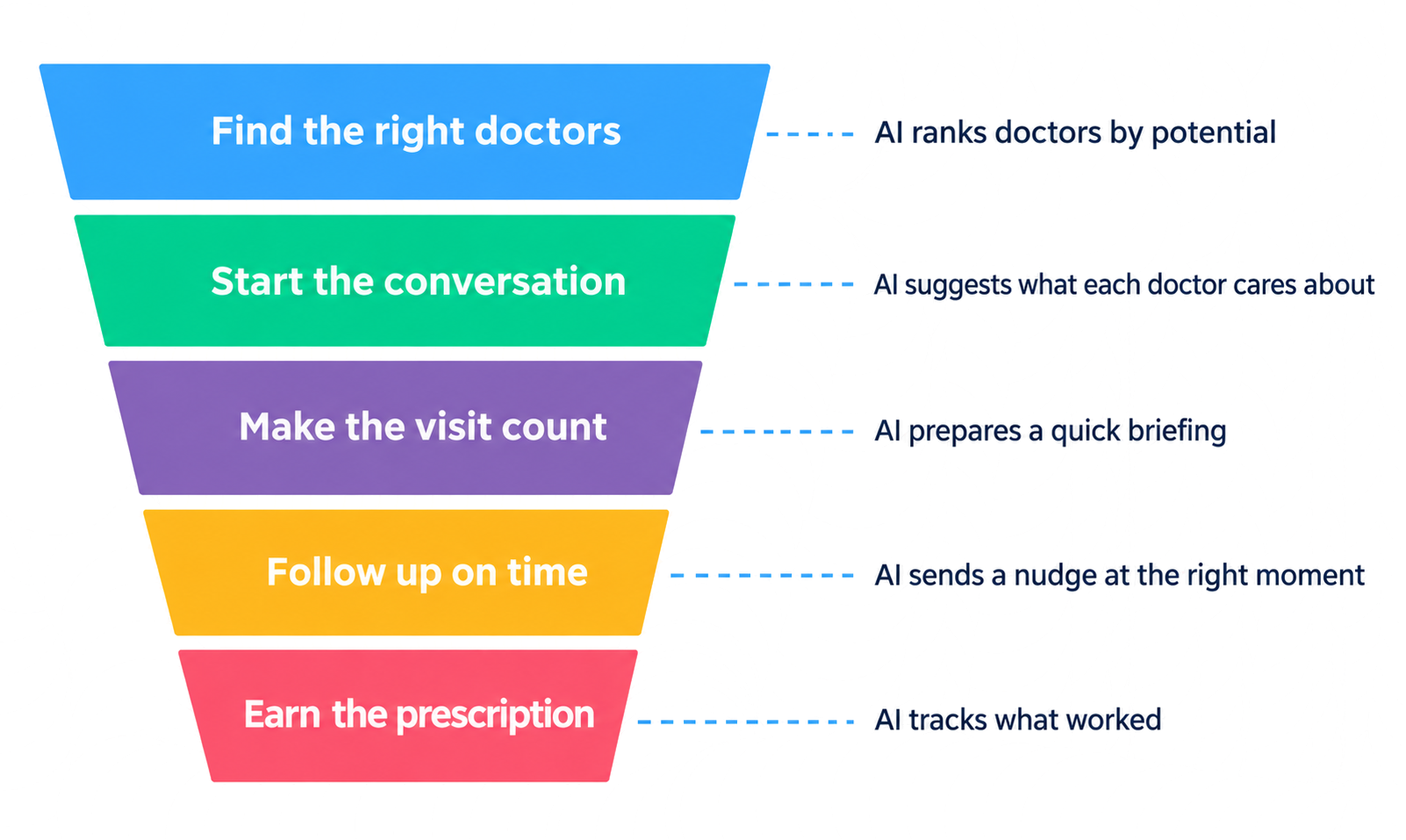
Most teams give every doctor roughly the same attention, but some doctors prescribe far more than others. AI ranks doctors and areas by how much they prescribe and how fast they are growing. Reps then spend more time on the ones that pay off, which raises your return on every visit without adding people.
2. Personalize Doctor Engagement
A doctor who gets the same pitch every time stops listening. AI tracks what each doctor has read, asked and shown interest in. The rep can then talk about topics that doctor actually cares about. This improves the numbers that matter, like repeat meetings and the number of doctors who start prescribing.
3. Make Every Doctor Visit More Productive
A doctor may give you only five minutes, so you can't waste any of them. Before the visit, AI shows the rep what was discussed last time, what the doctor asked and what to bring up now. The rep doesn't need more visits to get better results. The same visit simply achieves more.
4. Receive Intelligent Nudges and Next-Best-Action Suggestions
Managers track many numbers but often can't tell which one to fix first. Nudges solve this by giving reps a short, clear task, such as “call this doctor today” or “this area is slowing, visit it this week.” Small problems get fixed early, so the team stays on target instead of rushing at month-end.
Did You Know?
In a 2026 industry report, 76% of healthcare professionals said interactions with field teams positively influence their clinical decisions. The human conversation still matters, and AI helps it start better prepared.
5. Improve Sales Forecasting and Demand Planning
A forecast tells you how much you will sell next month. If it's wrong, you either run out of stock or end up with too much. AI sales forecasting studies past sales, seasons and market changes to give a more accurate number. This means fewer lost sales, less wasted stock, and targets that are realistic.
6. Understand Prescription and Sales Trends
Sales reports tell you sales dropped, but not why. AI connects sales with visits, campaigns and market changes to find the reason. For example, it may show that sales fell in a region even though visits stayed steady. Once you know the cause, you can spend money on what works and stop spending on what doesn't.
7. Measure Campaign Performance More Effectively
Many companies judge a campaign by how many emails were sent or how many events were held. That only measures effort, not results. AI shows how many doctors opened the message and how many acted on it afterwards. You can see which campaign earned back its cost and shift budget towards it.
8. Optimise Inventory and Sample Distribution
Samples and promotional materials cost money, and unused stock is a wasted money. AI predicts how much each area will need based on past use and expected demand. Reps always have what they need for a visit, and the company stops over-ordering. That cuts cost without reducing field activity.
Did You Know?
A Deloitte survey found that biopharma sales reps spend roughly two-thirds of their workday on tasks like researching clients, reviewing products and scheduling. Winning back even a small part of that time means more time with doctors.
9. Reduce Administrative Work for Medical Representatives
Every hour a rep spends on reports is an hour not spent meeting doctors. AI can turn a short voice note into a finished report and set up follow-up reminders automatically. Reps can then meet more doctors in the same working day, which raises coverage and call frequency without longer hours.
10. Strengthen Sales Coaching and Performance Management
A month-end review tells a rep what went wrong after it's too late to fix it. AI watches performance all through the month and points out specific issues, like a rep who meets many doctors but rarely follows up. Managers can coach that one skill right away. New reps improve faster, and more of the team reaches its targets.
Smarter Tools, Same Human Touch
All ten points lead to the same result: better targeting, more productive visits, more accurate forecasts and a higher return on the money spent. AI doesn't replace the representative. It gives them better information, and the relationship with the doctor stays human.
We believe in this too. We already have deep AI models working inside everyday field activities, including intelligent nudges, practical suggestions and forecasting that help teams plan with confidence.
In the end, selling well isn't about working harder. It's about seeing clearly.
Frequently Asked Questions
1. How is AI used in pharma sales?
AI is used to rank doctors by potential, suggest what to discuss in each visit, forecast demand, send reminders and nudges, and cut down paperwork. Its job is to help sales teams decide where to spend their time and money.
2. Will AI replace medical representatives?
No. AI handles the data work, such as research, reports and reminders, while the representative handles the conversation and the relationship. Doctors still value human interaction, and AI helps reps be better prepared for it.
3. How does AI improve sales forecasting in pharma?
It studies past sales, seasonal patterns, and market changes to estimate future demand more accurately than manual methods. This helps companies avoid stock-outs and overstocking and sets targets that are realistic.
4. Which sales KPIs can AI improve?
Common ones include productivity per call, call coverage and frequency, forecast accuracy, campaign ROI, inventory cost and quota attainment. The gains depend on the quality of the data and how well the insights are acted on.
5. Is it safe and compliant to use AI in pharma sales?
It can be, as long as it uses authorized, reliable data and approved content, and follows privacy and promotion rules. Companies should set clear guidelines and keep humans in charge of final decisions.
6. How can a company start using AI in sales?
Start with one clear problem, such as forecasting or doctor targeting, and make sure the underlying data is clean. Run a small pilot, measure results against a KPI, and then expand.


